Feeling the Heat: How Inequality Shapes Heatwave Experiences
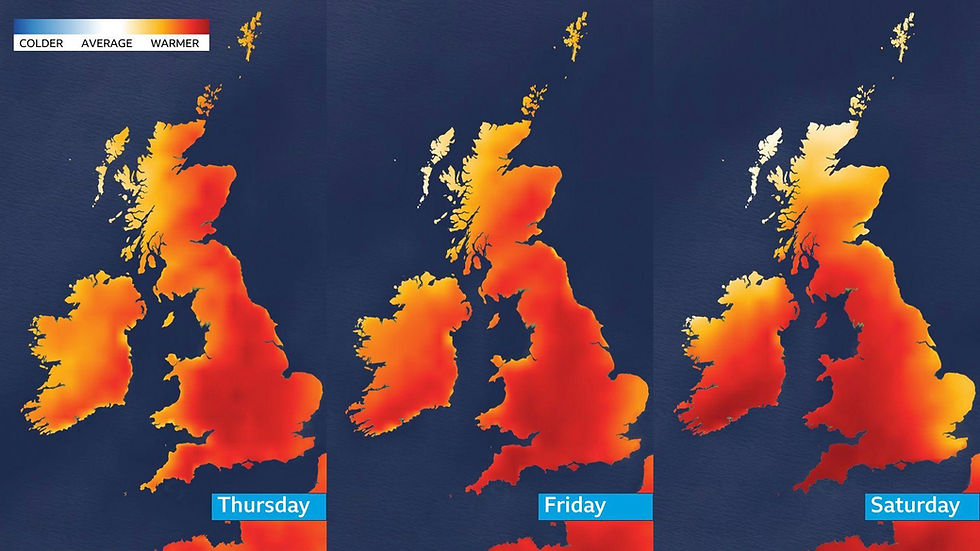
Image credits: BBC (2026) [Heatwave spreads further north and west as temperatures climb - BBC Weather]
For decades, climate scientists and activists have warned of the dangers of global warming and climate change. In recent years we have increasingly witnessed the climate crisis transcending national borders, no longer being confined to conventional areas that were known to experience extreme weather such as hurricanes, wild fires, and floods, to name a few. However, while the climate-crisis has expanded its reach rapidly across the world, the consequences for human populations are not experienced equally, either between countries or within them.
"Climate vulnerability is therefore not only about temperature but it is also about power, resources, and inequality."
Here in the UK, we may not yet have experienced the scale of and intensity of the climate crisis seen elsewhere in the world, but increasingly frequent periods of extreme heat demonstrate that it is far from immune. The UK experienced its first heatwave of 2026 in May, earlier than the first heatwaves of 2024 and 2025. While many welcomed the sunshine, unusually early and extreme temperatures also raised a more serious question: when the temperature rises, who is most able to escape the heat, and who is forced to endure it?
The effects of extreme heat are already well established. Heatwaves can contribute to illness and premature death, place additional pressure on health services, reduce economic productivity and affect agriculture. NHS England estimates that heat-related mortality in England currently costs around £6.8 billion annually (NHS: 2025), while analysis of the UK's 2026 heatwaves estimated at least £4.4 billion in lost economic output between May and July alone (Stewart: 2026).
While on one-hand these population-level effects are being better understood and documented, on the other hand, they can contribute to obscuring the micro-level impacts experienced by individuals and communities. For instance, a heatwave may cover an entire city or region, but people living within it often do not experience the same heat in the same way.
"Those on lower incomes may be more dependent on crowded public transport, work outdoors, or live in accommodation that is poorly equipped for extreme temperatures."
This is where an intersectional approach becomes particularly useful. Inequalities relating to income, gender, race, and ethnicity do not simply exist alongside extreme heat, but they can shape where people live, the work they undertake, the transport they use, the caring responsibilities they carry and the resources available to protect themselves. Climate vulnerability is therefore not only about temperature but it is also about power, resources, and inequality.
This unequal exposure is already visible globally. Wealthier countries such as the UK have greater resources with which to invest in infrastructure, adaptation, and emergency responses than many poorer countries such as Bangladesh and Sengal, that have experienced some of the most devastating consequences of climate change. These global inequalities also have a longer history, including histories of colonialism and unequal
patterns of resource extraction.
"...an intersectional lens invites us to ask a more compelling question...who is most exposed, who has the resources to adapt, and whose circumstances leave them with the fewest choices?"
Similar inequalities can be seen within the UK where socioeconomic position can substantially shape a person's ability to escape extreme heat. The UK has one of the higher levels of income inequality among OECD countries (OECD: 2022), and these economic inequalities can translate into very different experiences of extreme weather. More affluent people may have access to air-conditioned cars, cooler workplaces, or homes that can be adapted to rising temperatures. Those on lower incomes may be more dependent on crowded public transport, work outdoors, or live in accommodation that is poorly equipped for extreme temperatures.
Even something as apparently simple as switching on an electric fan depends upon being able to afford the additional energy costs. Housing also matters, as renters have less control over structural adaptations to their homes, while neighbourhoods with limited green space can provide fewer opportunities for relief during periods of extreme heat. The result is that two people living through precisely the same heatwave may have radically different capacities to protect themselves from it.
"These risks can be particularly heightened in contexts where women continue to undertake a disproportionate share of domestic and caring responsibilities..."
Gender can shape and even compound these experiences further. Researchers conducting a systematic review and meta-analysis examining sex differences in heatwave mortality found that women had an 8% higher risk of heat-related death than men, across the studies included in its meta-analysis (Pinho-Gomes et.al: 2024). The reasons behind such disparities are complex, however, and cannot be understood simply as a consequence of being female. They are also connected to the social and economic conditions through which gender operates. For example, women tend to experience heatwaves more severely as a result of the traditional roles they are expected to take on, and being more likely to partake in unpaid labour within the home, including (though not limited to) care work.
According to the WHO, intense temperatures in the home can negatively affect wellbeing, contributing to physical health problems, including cardiovascular and respiratory conditions, as well as sleep disturbance and other impacts on mental health (WHO, 2026). These risks can be particularly heightened in contexts where women continue to undertake a disproportionate share of domestic and caring responsibilities, increasing the time they spend working in homes and other environments that may be poorly adapted to extreme heat.
"...as calls for individuals simply to become more “resilient” risk overlooking the structural conditions that make resilience easier for some people than for others."
Race and ethnicity are also important factors, due to racial inequalities influencing where people live, the kinds of employment they undertake, and the economic resources available to them. Research into heat vulnerability in the UK has highlighted inequalities affecting minority ethnic communities, including through housing, deprivation, urban geography and access to green space (Gayle: 2022).
Applying an intersectional analysis should not suggest that being a woman, being from lower-socio-econimic bacgrounds, or belonging to a minority ethnic group by default makes some groups more vulnerable. Instead, an intersectional approach asks how different forms of inequality interact to produce a particular experience. For example, a woman earning a higher-income who is able to work from an air-conditioned office and live in a well-adapted home, may experience a heatwave very differently compared to a woman on a lower income, who is undertaking unpaid care and residing in overcrowded accommodation.
Similarly, ethnicity may intersect with income, occupation, housing, and neighbourhood conditions in ways that either increase or reduce exposure to extreme heat. These inequalities cannot always be separated neatly from one another as, in people's everyday lives, they operate together. Thus, examining heatwaves through an intersectional lens invites us to ask a more compelling question. Rather than asking how Britain should respond to rising temperatures, it requires us to ask: who is most exposed, who has the resources to adapt, and whose circumstances leave them with the fewest choices?
"As extreme weather becomes a more familiar feature of British summers, climate adaptation cannot be separated from questions of equality."
That has important implications for public policy, as calls for individuals simply to become more “resilient” risk overlooking the structural conditions that make resilience easier for some people than for others. Advice to stay cool has limited value to someone who cannot afford increased electricity costs, cannot leave an overheated workplace, relies on crowded public transport, or lives in accommodation that traps heat.
Responses to extreme heat must therefore take inequality seriously. Measures could include targeted support with energy costs during periods of extreme heat, improving ventilation and cooling in schools, and public transport, increasing access to drinking-water fountains, expanding urban green space, and opening suitably cooled public buildings as accessible community spaces during heatwaves.
As extreme weather becomes a more familiar feature of British summers, climate adaptation cannot be separated from questions of equality. The temperature on the thermometer may be the same, but people's ability to live safely through it is not. An effective response to climate change must recognise not only that Britain is getting hotter, but that inequality determines who feels that heat most.
References and further reading
NHS England (2025), 4th Health and Climate Adaptation Report. NHS England estimates that heat-related mortality in England costs approximately £6.8 billion annually and could rise substantially by the 2050s.
World Health Organization, Climate change and health.WHO resources on the health consequences of climate change, including the risks posed by extreme heat.
European Journal of Public Health (2024), Sex differences in mortality associated with heatwaves: a systematic review and meta-analysis.The meta-analysis found an 8% increased risk of heatwave-associated mortality among women compared with men, while also identifying variation between studies.
Verdant (2026), The Cost of Heat: Summer 2026 UK heatwaves.Analysis estimating that the May–July 2026 heatwaves resulted in at least £4.4 billion in lost UK economic output.
OECD, Income Distribution Database.Comparative data on income inequality and income distribution across OECD countries.


Comments